
For many organisations, Microsoft Dynamics NAV has been a dependable business system for years. It has helped finance teams, operations departments, warehouse staff and management teams run critical day-to-day processes successfully.
If your NAV system still works, it may be tempting to assume there is no need to change.
However, ERP systems rarely become a problem overnight. More often, the signs appear gradually. A spreadsheet is created to fill a reporting gap. An integration becomes difficult to support. A bespoke development becomes harder to modify. Over time, these workarounds can create additional complexity, risk and inefficiency across the business.
With Microsoft Dynamics NAV moving further beyond mainstream support and key licensing changes already announced for 2031, many organisations are taking the opportunity to review whether their current ERP system is helping them move forward or holding them back.
Here are seven signs that Dynamics NAV may be becoming a constraint on your business, even if it continues to operate today.
1. Your Reporting Depends on Spreadsheets
One of the most common indicators that an ERP system is no longer meeting business requirements is a heavy reliance on spreadsheets.
If users regularly export data from NAV before manipulating it in Excel, there is a strong possibility that reporting processes have evolved beyond what the system can easily provide.
You may find that:
- Different departments maintain separate versions of reports
- Management information requires manual preparation
- Users spend significant time exporting and reconciling data
- Decisions are delayed while reports are updated
The challenge is not simply the time involved. Manual reporting introduces the risk of inconsistencies, version control issues and human error.
Modern ERP platforms such as Dynamics 365 Business Central offer integrated reporting capabilities and work closely with tools such as Power BI, helping organisations access business insights more efficiently.
At Synergy Technology, we help organisations move beyond spreadsheet-driven reporting by reviewing existing processes and identifying opportunities to improve visibility and accuracy within Dynamics 365 Business Central.
2. Your Teams Rely on Manual Workarounds
When systems no longer fit the way a business operates, employees naturally find alternative ways to get work done.
What starts as a temporary workaround can eventually become a critical part of day-to-day operations.
Examples might include:
- Re-entering data into multiple systems
- Tracking approvals through email chains
- Maintaining information outside NAV
- Using documents and spreadsheets to bridge process gaps
While employees often become highly effective at managing these workarounds, they can create duplication, inefficiency and increased operational risk.
A modern ERP should support your processes rather than force your teams to work around system limitations.
Our consultants work closely with organisations to understand how users really work day to day. By combining Business Central with technologies such as Power Automate and Microsoft 365, we help streamline processes, reduce duplication and eliminate many of the manual tasks that consume valuable time across the business.
3. Only a Few People Understand the System
Many long-established NAV implementations have evolved over years or even decades.
As systems grow, knowledge often becomes concentrated among a small number of individuals who understand specific reports, bespoke developments, integrations or configurations.
This can create challenges when:
- Key employees retire or leave
- Support providers change
- New staff require training
- System changes need to be implemented
If certain business processes depend on one person knowing how NAV works behind the scenes, the organisation may be carrying more risk than it realises.
A review of your current environment can help identify these dependencies before they become a business continuity issue.
Having supported Dynamics NAV customers for many years, we understand the challenges that can arise when critical knowledge sits with only a handful of individuals. Our team can help document existing processes, review system dependencies and create a clear roadmap that reduces risk while preparing your organisation for the future.
4. Bespoke Developments Are Becoming Harder to Change
One of the most common reasons organisations delay a move from Dynamics NAV is concern about bespoke developments.
Many businesses have invested significantly in custom functionality, reporting and integrations over the years, making it understandable that they want to preserve that investment.
However, bespoke development is not automatically a barrier to moving to Business Central. In fact, a migration project can provide a valuable opportunity to assess what still delivers value and what may no longer be required. Existing functionality should be reviewed to determine whether Business Central can now deliver the same capability through standard functionality or whether a modern extension approach would be more suitable.
At Synergy Technology, one of the first steps in a NAV assessment is understanding how bespoke developments support the business today and identifying the most effective path forward.
For many organisations, the best option may be a migration. For others, a re-implementation may provide greater long-term benefits.
One of our key strengths is helping organisations navigate complex NAV environments. We regularly assess bespoke developments, custom reports and integrations to determine what can be replaced with standard Business Central functionality, what should be retained, and what may benefit from redevelopment using modern technologies. This helps organisations make informed decisions and avoid unnecessary project costs.
5. Integrations Are Becoming More Difficult to Maintain
Businesses today rely on a growing ecosystem of connected applications.
Your ERP system may need to exchange data with:
- CRM systems
- Ecommerce platforms
- Payroll software
- Warehouse management solutions
- Reporting tools
- Manufacturing systems
As NAV environments age, integrations can become increasingly complex to support and modify.
In some cases, organisations find that introducing new technologies requires significant development effort simply because the ERP platform was not designed for the level of connectivity expected today.
If integrations are becoming difficult to maintain, it may be a sign that your technology landscape has moved beyond what your current NAV environment can comfortably support.
Synergy Technology has extensive experience integrating Microsoft business applications with CRM systems, ecommerce platforms, payroll solutions, warehouse management systems and other third-party applications. We can help simplify your technology landscape and create integrations that are easier to support and maintain as your business evolves.
6. On-Premises Infrastructure Requires Increasing Attention
Many NAV users continue to run their system on-premises.
While this approach may have worked well for many years, it often places additional responsibility on internal IT teams and business resources.
Areas that require ongoing attention include:
- Server management
- Backups
- Disaster recovery
- Security updates
- Infrastructure upgrades
- System availability
As technology evolves, maintaining older infrastructure can become increasingly costly and time-consuming.
Cloud-based ERP solutions such as Dynamics 365 Business Central can help reduce this burden while providing access to regular updates, enhanced security features and greater flexibility.
As a Microsoft solutions partner, we help organisations evaluate the practical benefits of moving from on-premises environments to Business Central’s cloud platform. From planning and implementation through to training and ongoing support, we provide end-to-end services that help reduce risk and ensure a smooth transition.
7. NAV No Longer Reflects How Your Business Operates
Perhaps the clearest sign that NAV is becoming a constraint is when the business itself has changed significantly since the system was first implemented.
Your organisation may have:
- Expanded into new locations
- Increased headcount
- Added new products or services
- Introduced new customer requirements
- Adopted different working practices
- Experienced growth through acquisition
If the system no longer reflects how the business operates today, even well-supported customisations can become increasingly difficult and expensive to maintain.
Rather than asking whether NAV still works, it may be more useful to ask whether it still supports where the business wants to go next.
Every business evolves over time, which is why we take a consultative approach to every Business Central project. Rather than simply replacing software, we work with organisations to understand their goals, processes and future plans, ensuring the solution supports both current requirements and long-term growth.
Why Waiting Could Make Migration Harder
Many organisations recognise the need to modernise but assume there is plenty of time to address it later.
While Microsoft’s licensing changes do not take effect until 2031, ERP projects should not be viewed as last-minute activities. They require planning, stakeholder engagement, system reviews, testing, data preparation and user adoption. Microsoft has already announced that from 30 April 2031 customers will no longer be able to renew annual service plans or subscription licences, purchase additional perpetual NAV licences or continue subscription use through SPLA.
Starting the conversation now gives organisations greater flexibility, reduces project risk and helps ensure migration decisions are made based on business objectives rather than external deadlines.
Financial Support May Be Available for Your Move
Cost is often one of the biggest concerns when reviewing a move from Dynamics NAV to Business Central.
However, Microsoft currently offers initiatives designed to support eligible Dynamics customers moving to the cloud.
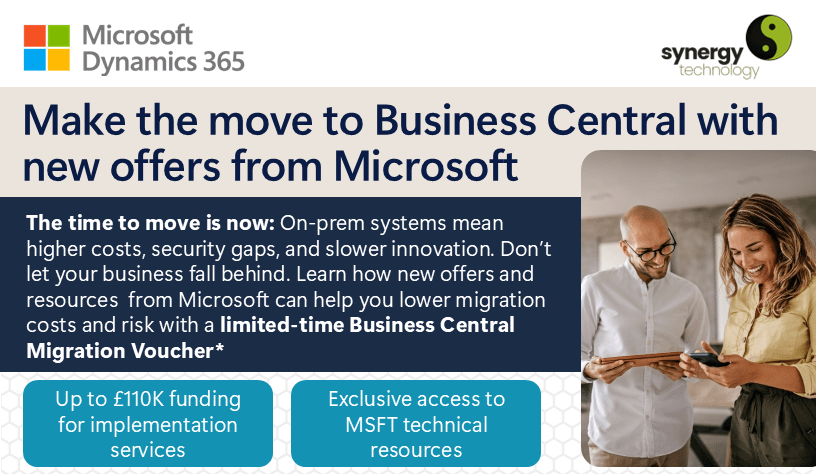
The Business Central Migration Voucher provides funding towards qualifying migration and implementation services, helping to reduce the cost of moving from on-premises Dynamics solutions to Business Central. Microsoft has also introduced Bridge to Cloud 3, which offers qualifying customers discounted Dynamics 365 licences while transitioning to cloud solutions.
As these programmes have eligibility requirements and limited availability, many organisations are choosing to assess their options sooner rather than later.
What Should NAV Users Do Next?
Recognising one or more of these signs does not necessarily mean you need to migrate immediately.
It does suggest that now is the right time to understand your options.
An initial review can help assess:
- Your current NAV version
- Existing data quality
- Bespoke developments
- Integrations
- Reporting requirements
- Future business objectives
From there, you can make an informed decision about whether migration, re-implementation or a combined approach is the most suitable route forward. This assessment-led approach aligns with Synergy Technology’s guidance for NAV customers evaluating Business Central.
The earlier that process begins, the more time you have to plan a controlled, low-risk transition to Dynamics 365 Business Central.
Customer Success Stories
Many businesses have already migrated from Dynamics NAV to Business Central with the help of Synergy Technology.
- Basingstoke and Deane Borough Council Successfully Migrates to Microsoft Dynamics 365 Customer Service in the Cloud
- MPG Contracts Ltd Build Efficiency and Trust with Microsoft Dynamics 365 Business Central and Synergy Technology
- Albion Valves Power Growth and Productivity with Microsoft Dynamics 365 Business Central
Is NAV Becoming a Constraint on Your Business?
At Synergy Technology, we have over 20 years of experience supporting Microsoft Dynamics solutions, from Dynamics NAV through to Dynamics 365 Business Central. Our team helps organisations understand their current environment, assess their options and build a practical roadmap for the future.
Whether you’re considering a migration, a re-implementation or simply want to understand what Microsoft’s upcoming changes mean for your organisation, we’re here to help.
Call 0345 456 0050 for a no-obligation conversation and discover how Synergy Technology can help you plan your move to Dynamics 365 Business Central.
Follow us on social media: